Vibe manufacturing explained: from words to real parts
Vibe manufacturing explained: how AI turns a plain-language description into a fabricated part, and why iteration costs add up fast.
On this page
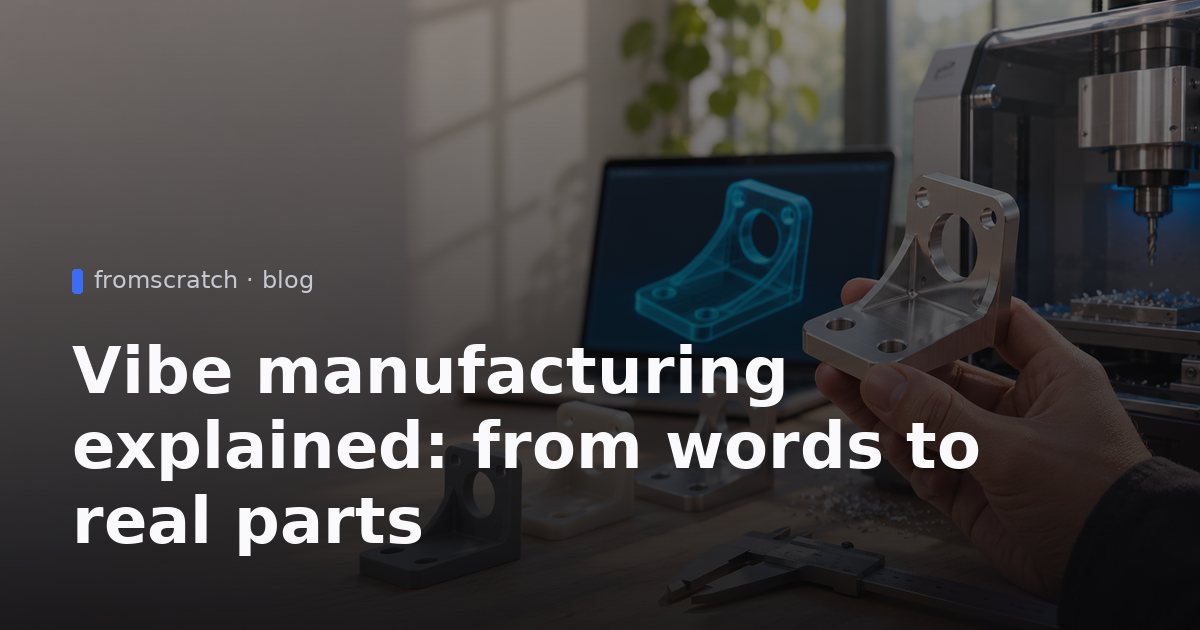
Vibe manufacturing explained in one line: you describe a physical object in plain language, AI turns that description into a fabrication file, and a 3D printer, online fabricator or small-batch maker produces it. A recent Gadget Review report shows that people are already doing this with real parts, not just demos. The lessons apply beyond hardware. If you build apps without writing code, the same trade-offs between speed and verification show up in software too.
What vibe manufacturing means
The term describes natural-language descriptions converted by AI into CAD (computer-aided design) or fabrication files. Those files then go to a 3D printer, an online fabricator or a small-batch manufacturer. As Gadget Review reports, the name deliberately echoes vibe coding, the practice of using conversational AI to write software.
That link is useful. Vibe coding lets someone describe an app and get working code without learning a programming language. Vibe manufacturing applies the same idea to a bracket, an enclosure or a toy. The difference is that the output is a physical object you can drop, overheat or hand to a child.
A text-to-CAD AI tool is the core piece. It takes a prompt such as "a steel bracket with two 6 mm holes that clamps to a 40 mm rail" and produces geometry you can review, edit or send to a fabricator. Gadget Review's coverage makes one point clear: the conversion step is fast, but the result still needs checking.
What happened in the reported cases
Gadget Review's report draws on Business Insider's reporting on several makers. Their experiences vary, and the differences matter.
The steel part order
Jeff Deehan, a real estate developer in East Lansing, Michigan, described a small steel component that would secure a camper to his truck. Speaking into the voice mode of GPT-6 Astra, he watched the AI generate a DXF file, open the online fabricator SendCutSend, fill in the order form and pay $156 from stored payment details. The part arrived ten days later. His summary: "In about 10 minutes, I spoke a part out of my mind into existence, without touching my phone."
That is a striking workflow. It also skipped the step where someone checks whether the part will fit the truck and hold the load.
Failed iterations and costs
The most instructive case involves Jake Fitzgerald. He used an open-source text-to-CAD tool, developed by Amy Zhou and Jake Fitzgerald with the aim of producing manufacturable designs from natural-language prompts. The project had more than 23,000 GitHub stars at the time of reporting. Fitzgerald designed a sheet-metal robot arm with a 0.6-meter reach, which SendCutSend fabricated for roughly $200 in parts.
Getting there was expensive. Earlier versions produced compounding failures, where one design mistake carried into the next iteration. Fitzgerald reportedly spent about $2,000 on failed parts before the workflow improved. The cheap part was the description. The expensive part was the iteration.
The other examples
The range is wider than robotics:
- Jewelry: Zhou uses AI to generate jewelry, continuing work she started at an earlier startup that converted uploaded images into 3D wax-cast charms.
- Medical models: Sourish Sharma, a 20-year-old in London, turned MRI data into a 3D-printable brain model. He said the AI workflow needed less manual correction than the open-source tool he had used before. That describes one personal project, not a validated clinical method.
- Children's toy: Arthur Prince, an IT worker near Paris, designed a voice-activated toy that generates stories and images. He used GPT-6 Astra for hardware design, Claude to critique it, and ordered 10 units from JLCPCB for about 500 euros. His daughter tested the first working version.
- Answering machine: David Plakon, a tinkerer near Austin, built a small answering machine with an ESP32 chip, a speaker, a potentiometer and a 3D-printed enclosure. He reprinted the enclosure roughly 15 times while fixing fit and assembly problems. The device works, but he does not consider it ready for a factory.
Each example shows a working first version. None of them shows a finished, certified product.
Why physical mistakes cost more than software bugs
A software bug usually means a broken button, a slow page or a bad calculation. You fix it, redeploy and move on. A flawed physical design produces an object that fails, needs reprinting or creates a safety risk. Gadget Review frames the parallel to vibe coding as "useful but incomplete" for this reason.
The responsibilities stay with the builder. Gadget Review's reporting lists them: verifying tolerances, materials, electrical safety, child-safety requirements, regulatory compliance and intellectual-property considerations. The AI can draft a design, but it does not take responsibility for whether the design holds weight, overheats or meets a standard.
Iteration cost is the hidden variable. Fitzgerald's roughly $2,000 in failed parts and Plakon's 15 printed enclosures show how quickly a "cheap" prototype becomes expensive. This is the core of the prototype cost of AI-designed parts: the price per attempt is small, but the number of attempts is hard to predict.
What this means if you build apps without code
The same pattern holds in software. A prompt can produce a working tracker, booking page or dashboard within minutes. That working prototype is not yet a production system. Data needs to be stored safely, users need the right permissions, and someone has to decide what happens when things go wrong.
If you have not thought through the hidden work, read Vibe coding an app: what a quick prototype hides. It covers the gap between a demo and something people can rely on.
Responsibility is also the same. Whether you are building a physical product or a web app, you are accountable for what you publish and what data you collect. Vibe coding legal risks: prompt safely explains which duties stay with you.
Vibe coding vs vibe manufacturing comes down to this. Both let you move from idea to first version in a single session. Both leave verification, iteration budgets and compliance to you. The difference is that a software mistake can usually be undone with a new version, while a physical mistake leaves plastic or steel on your desk.
How to test an AI-built idea before you commit money
The reported makers got value by treating their first attempts as experiments. You can do the same, whether you are ordering a part or publishing an app.
- Write acceptance criteria first. Before you generate anything, list what success looks like. For a bracket: "holds 20 kg, fits a 40 mm rail, costs under $50 per unit." For an app: "a team member can log a repair request in under a minute and see its status."
- Set a budget cap. Decide how much you will spend on failed attempts before you stop and rethink. Fitzgerald's $2,000 is a useful warning here.
- Log every version. Record the date, the description you gave, the cost, what failed and the fix. Patterns show up quickly. Repeated failures often point to a missing constraint in the prompt, not bad luck.
- Get a qualified review for anything risky. Safety, certification, children's products and scale-up need professional engineering judgment. Gadget Review's conclusion is direct: for those cases, "no voice prompt changes that yet."
- Keep the first version small. A working prototype that you can test with five people is worth more than a feature-complete build nobody has checked.
Build it with FromScratch
You can apply the logging habit to your own projects with a simple tracker. Here is how to build one in FromScratch, the AI app builder that turns plain-language descriptions into working apps. For background, see What is an AI app builder.
- Open FromScratch and start a new project. Describe what you want in the chat. You do not need to choose a stack. FromScratch builds a React front-end, a Python (FastAPI) back-end and a database.
- Paste the prompt below. It describes the tracker in plain language, including the fields you need and the login requirement.
- Check the live preview. The app runs in a preview within minutes. Add a few test entries and check that totals and open issues update correctly.
- Refine by chat. If a field is missing or the dashboard is hard to read, say so. For example, "add a status filter for unresolved issues" or "show spend in a bar chart."
- Attach reference files if needed. You can attach images, PDFs and spreadsheets. Photos of a prototype can help you see changes over time, but attach them to the app's entries only after you have built the upload step.
- Use version history. Every change is saved, so you can restore an earlier version if a refinement breaks something.
- Publish when you are ready. You can publish to a public URL or your own custom domain. Keep the login requirement on so each user sees only their own projects.
Build a web app called Prototype Log where I can create a project and add a dated entry for each version I try, with a description, cost, what failed and the fix. Show a dashboard with total spend per project, a list of unresolved issues, and a way to upload photos or design files to each entry. Require login so each user sees only their own projects.
FromScratch has a free plan to start, and paid plans add credits and projects. Check pricing for current details before you commit.
FAQ
Is vibe manufacturing the same as vibe coding?
They share the conversational approach: you describe what you want, and AI produces a working draft. Vibe manufacturing adds a physical layer, where a failed design means a reprint, a waste of material or a safety risk. Software mistakes can usually be fixed and redeployed more cheaply.
Can AI-generated designs go straight to a factory?
The makers Gadget Review describes did not claim that. Plakon, for example, said his answering machine is not ready to send to a factory. For anything that needs safety certification, tight tolerances or large-scale production, have a qualified engineer review the design first.
What is the real cost of an AI-designed prototype?
The price of a single part can be low, but iteration adds up. Fitzgerald reportedly spent about $2,000 on failed parts before his workflow improved. Set a budget cap and log each version so you can see where the money goes.
Where should I start if I only want to build software?
Start with a small, clearly defined tool and follow Vibe coding for non-coders: a practical starter guide. If you get stuck while building, you can reach the team through contact and support.
Sources